Qt Python Signal Slot
Qt Tutorials For Beginners 5 - Qt Signal and slots - Duration: 11:33. ProgrammingKnowledge 119,341 views. Former CIA Officer Will Teach You How to Spot a Lie l Digiday - Duration: 47:47. The Signalclass provides a way to declare and connect Qt signals in a pythonic way. PySide adopt PyQt’s new signal and slot syntax as-is. The PySide implementation is functionally compatible with the PyQt 4.5 one, with the exceptions listed bellow. The signals and slots mechanism is a central feature of Qt. In GUI programming, when we change one widget, we often want another widget to be notified. More generally, we want objects of any kind to be able to communicate with one another. Signals are emitted by objects when they change their state in a way that may be interesting to other objects.
Latest versionReleased:
Simple Signal/Slot implementation
Project description
signalslot: simple Signal/Slot implementation for Python
This package provides a simple and stupid implementation of the Signal/Slotpattern for Python.Wikipedia has a nice introduction:
Signals and slots is a language construct introduced in Qt forcommunication between objects[1] which makes it easy to implement theObserver pattern while avoiding boilerplate code.
Rationale against Signal/Slot is detailed in the “Pattern”section of the documentation.
Python Qt Signal Slot
Install
Install latest stable version:
Install development version:
Uninstall
Release historyRelease notifications RSS feed
0.1.2
0.1.1
0.1.0
0.0.11
0.0.10
0.0.9
Qt Python Signal Slot Machine
0.0.8
0.0.7
0.0.6
0.0.5
0.0.4
0.0.3
0.0.2
0.0.1
Download files
Download the file for your platform. If you're not sure which to choose, learn more about installing packages.
| Filename, size | File type | Python version | Upload date | Hashes |
|---|---|---|---|---|
| Filename, size signalslot-0.1.2.tar.gz (8.0 kB) | File type Source | Python version None | Upload date | Hashes |

Hashes for signalslot-0.1.2.tar.gz
| Algorithm | Hash digest |
|---|---|
| SHA256 | 676e913cd6aefb8ef5f5ef368cc85bd8bc8847a12fb00348f2bdfe78abb0e3de |
| MD5 | a4d27da18f70b2ebd9cfc4f782e6aa90 |
| BLAKE2-256 | 3f2f237410ca5e28ee68ab84587bc2314d7fac75ce67c91148133c1eefc0ed16 |
This article mainly introduces PyQt5 daily must learn events and signals related information, has some reference value, interested partners can refer to
In this section we will explore how PyQt5’s events and signals are implemented in the application.
Book: Create Desktop Apps with Python PyQt5
Events
All GUI applications are event-driven. Application events are generated primarily from users, but they can also be generated by other means, such as an Internet connection, a window manager, or a timer. When we call the exec_() method of the application, the application enters the main loop. The main loop detects various events and sends them to the event object.
In the event model, there are three participants.
- event source
- event object
- event target
An event source is a change in the state of an object that generates an event. An event object (event) is an object that encapsulates a state change in the event source. The event target is the object that wants to be notified. The event source object represents the task of processing an event to the event target.
PyQt5 uses a unique signal and slot mechanism to handle events. Signals and slots are used for communication between objects, and when a particular event occurs, the signal is fired. The slot can be any Python call. The connection to the slot is called while the signal is transmitting.
Signals & slots
Here’s a simple example to demonstrate PyQt5’s signal and slot.
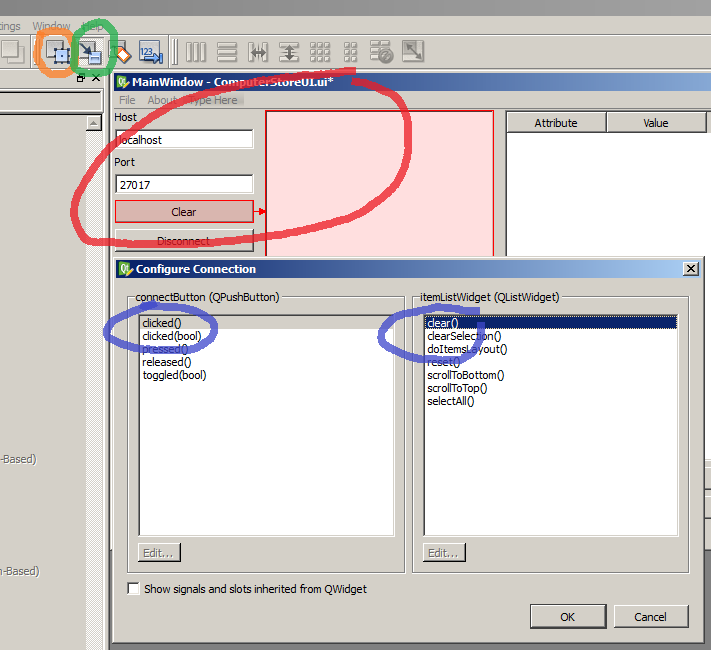
In our example, QtGui.QLCDNumber and QtGui.QSlider will be used. we change the LCD numbers by dragging the slider.
Here, the slider’s valueChanged signal is connected to the LCD’s display (display) slot.
A transmitter is an object that sends a signal. The receiver is the object that receives the signal. What slots is the method of feedback to the signal.
Overwrite the system event handler. You can use any key to fire an event.
In the example below the escape key triggers an event that quits the program.
Qt For Python Signal Slot
In our example, we reimplement the keyPressEvent() event handler.
If we press the Esc key on the keyboard, the application terminates.
Book: Create Desktop Apps with Python PyQt5
Event sender event send
To facilitate differentiation of multiple event sources connected to the same event target, the sender() method can be used in PyQt5.
In our example there are two buttons. Both buttons are connected to the buttonClicked() method and we respond to the clicked button by calling the sender() method.
Python Qt Signal Slot Example
The two buttons are connected to the same slot.
We determine the signal source by calling the sender() method. In the application’s status bar, the label of the button that was pressed is displayed.
Customized emission signals
An object created from a QObject can signal. In the following example, we’ll look at how we can customize the signal sent.
We create a new signal called closeApp. This signal is emitted by the mouse press event. This signal is connected to the close() slot in QMainWindow.
Creates a Communicate class inherited from QObject, which has a property of the pyqtSignal() class.
Qt Designer Python Signal Slot
Connect our custom closeApp signal to the close() slot in QMainWindow.
The CloseApp signal is emitted (emit) when our mouse clicks in the program window: application termination.
Book: Create Desktop Apps with Python PyQt5